Services
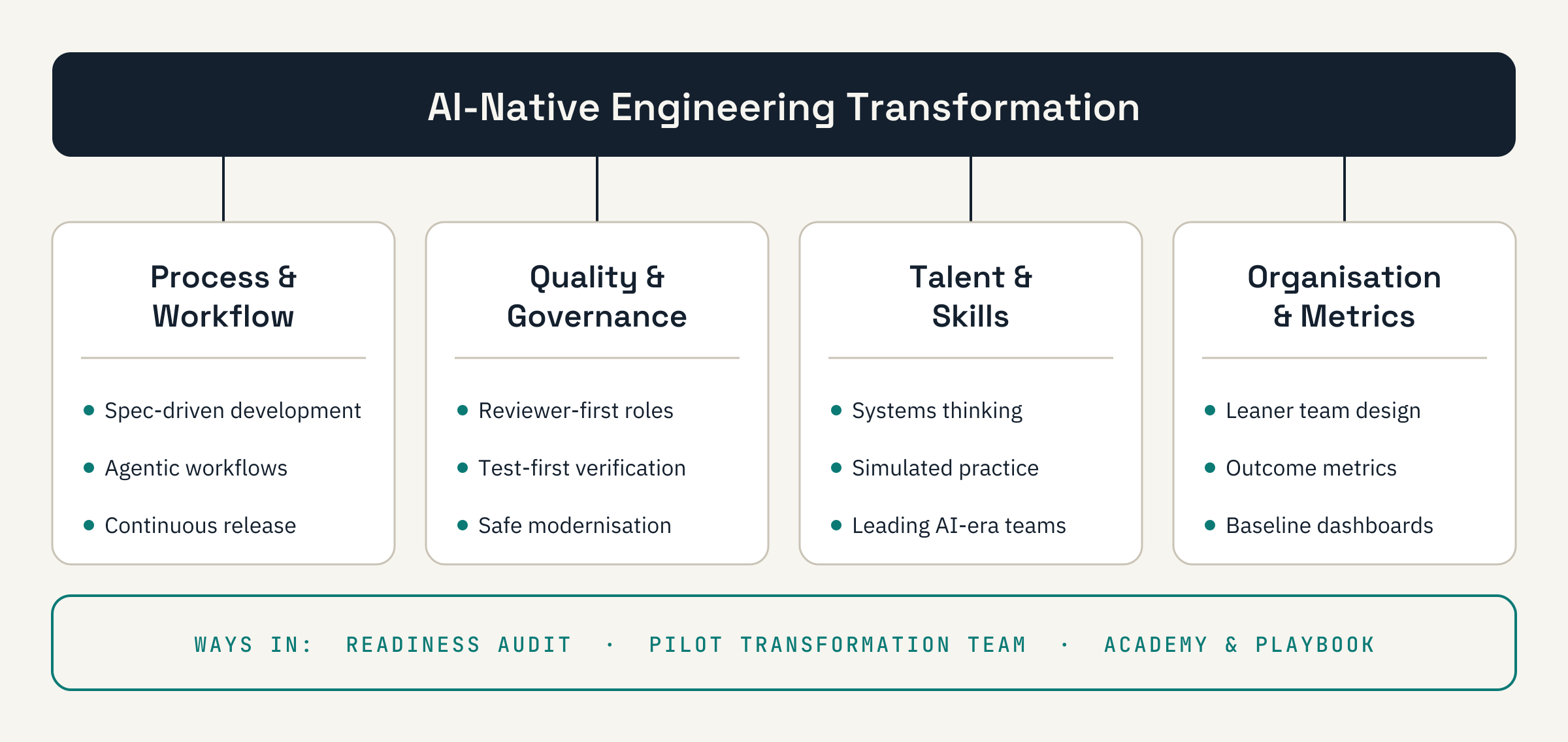
AI-Native Engineering Transformation
An operating-model change for engineering organisations — not tool training. Every engagement starts with understanding where your teams actually are, then changing one thing that matters, and measuring it.
Pillar 1
Process & Workflow — Agile for AI-speed delivery
Sprints, story points and ticket-shuffling were designed for a world where writing code was the bottleneck. It no longer is.
- Spec-driven development: teams write precise, machine-readable specs and contracts; AI agents implement against them.
- Agentic workflows: AI triages, reproduces and drafts; engineers decide and sign off.
- Continuous release: smaller, event-driven releases with automated checks and rollback.
Pillar 2
Quality & Governance — reviewer-first engineering
AI writes code faster than people can review it. Without new guardrails, the result is subtle defects, security gaps and architectural drift.
- Reviewer-first roles: senior engineers shift from writing to inspecting, backed by automated policy, licence and security checks.
- Test-first verification: people own the test harness; AI writes code to make it pass.
- Safe modernisation: phased, AI-assisted refactoring of legacy code, with clear rules on which code is disposable.
Pillar 3
Talent & Skills — the new apprenticeship
If juniors no longer write the boilerplate, how do they become tomorrow’s architects?
- Systems thinking: a curriculum in design, data and domain modelling, debugging and context engineering.
- Simulated practice: juniors diagnose and review AI-generated failures in safe environments, building judgement faster.
- Leading AI-era teams: coaching managers to lead teams of engineers and agents.
Pillar 4
Organisation & Metrics — measuring what matters
Velocity and lines of code say nothing useful once AI writes the code.
- Leaner team design: smaller, cross-skilled teams with fewer handoffs, sized to your context.
- Outcome metrics: DORA metrics, lead time from spec to production, change failure rate and review load.
- Baseline dashboards: a before-and-after view leadership can trust.
Ways to engage
Most clients start with the Readiness Audit. It gives you a baseline and a plan, whether or not we work together after that.
2–3 weeks
Readiness Audit
For: CTOs and VPs of Engineering.
You get: an assessment of AI tool usage, code and review quality, delivery metrics and security posture, plus a roadmap to AI-native workflows.
6–8 weeks
Pilot Transformation Team
For: Heads of Engineering and Product.
You get: one critical team moved to spec-driven, agentic development, with before-and-after metrics as your internal reference case.
4–6 weeks
Academy & Playbook
For: Heads of L&D and engineering leads.
You get: AI review guidelines, architectural guardrails, and training for engineers and managers.
How an engagement works
- A 30-minute conversation about where your engineering organisation is today. No charge.
- A short written proposal with scope, outcomes and fee.
- The engagement, with a mid-point and an end-point review against the measures we agreed.